
English Summury
English Summury
English Summury
Stability from the beginning
Flighter began with two observations. Hydrofoils are remarkably efficient, but making a foil borne boat truly stable is difficult.
Our starting idea was simple: three wings placed far apart create a broad, inherently stable triangular platform. Our first flying prototype then demonstrated another important principle. Front canard wings provide exceptionally effective control of flight height, pitch and roll.
Those ideas became the foundation of Flighter. If stability is built into the basic architecture of the boat, everything that follows has an easier job.
Flying should make boating easier
Foiling can dramatically reduce resistance by lifting most of the hull out of the water. But efficiency alone is not enough.
For Flighter, the technology must serve the person using the boat. A flight system should contribute to stability, comfort and safety, not turn boating into a technical exercise.
Our goal is a boat that feels natural and predictable. The advanced technology should work quietly in the background. The driver should not need to understand flight dynamics, constantly watch instruments or learn complicated procedures.
Technology should adapt to people, not the other way around.
A different approach to stability
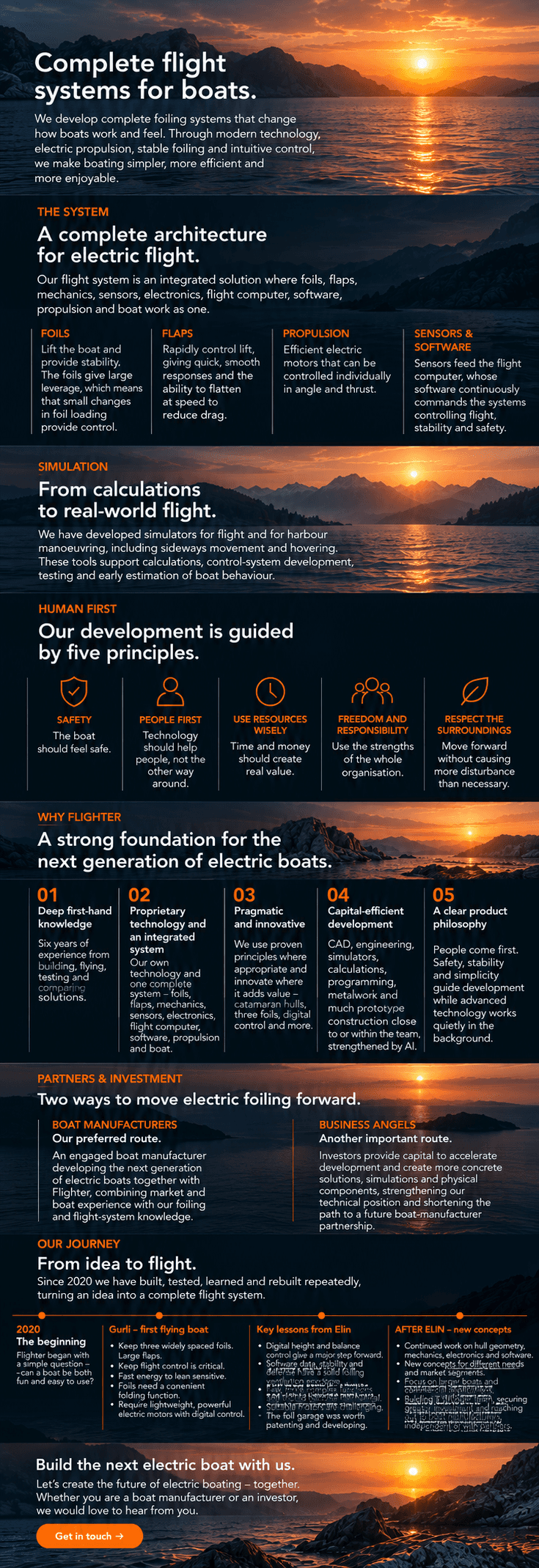
The Flighter system uses three wings placed far apart to create a broad and stable flying platform. Two front canard wings and one rear wing support the boat in flight.
The front wings actively regulate flight height, pitch and roll. Flaps continuously change the lift produced by the wings, allowing the control system to react quickly to speed, waves, weight distribution and other changing conditions.
Sensors, electronics, actuators, the flight computer and software work together as one system.
The important principle is that the digital control system does not have to create stability from nothing. It works on top of a fundamentally stable physical configuration.
The foil garage
Foils create a particular problem for practical boats. The very wings that make the boat efficient at speed can become inconvenient when entering a harbour, approaching a beach, operating in shallow water or servicing the boat.
Flighter has developed and patented a foil garage that allows the front wings to fold into the hull when they are not needed.
This means the underwater shape of the hull can remain unaffected by the front wings in displacement mode. It also removes the wings from the sides of the boat when manoeuvring around docks and other boats.
The foil garage is one of our patents, but Flighter's technology is much broader than one invention. Much of the value lies in how the different parts work together.
Six years of learning
Flighter has grown through practical development.
We have built and flown test platforms at different scales. We have worked with hulls, wings, flaps, mechanics, sensors, electronics, actuators, control systems, software and propulsion.
Some ideas worked. Others did not. Both have been valuable.
Over time we have also developed our own simulators, calculation tools and development methods. These allow us to explore new boat configurations, wing geometries, control strategies and operating conditions before committing time and money to physical prototypes.
AI has become another important development tool, helping a small team work across disciplines that would traditionally require a much larger organisation.
We learn from reality.
Safety begins with accepting that technology can fail
A modern foiling boat depends on technology. Pretending that every sensor, actuator, computer and electrical connection will always work would be poor engineering.
Our approach starts from the opposite assumption.
Components can fail. Signals can disappear. Water eventually finds places where nobody expected it. People make mistakes.
The system should therefore be designed to detect problems, tolerate failures where possible and react in predictable ways. Redundancy, monitoring and safe behaviour should be considered from the beginning rather than added afterwards.
For us, safety is not one component. It is a way of designing the complete system.
Efficiency changes the energy equation
One of the most important consequences of foiling is the dramatic reduction in resistance. That makes electric propulsion much more practical.
Instead of compensating for an inefficient boat with increasingly large batteries, reducing the continuous power requirement allows the same stored energy to take the boat much farther.
But we do not believe this necessarily limits the future to pure battery electric boats.
A highly efficient foil borne boat could also make hybrid solutions attractive. If the continuous power requirement is low enough, a relatively small generator can provide substantial additional range while electric motors retain many of their advantages.
Our interest is not in defending one particular source of energy. It is in making the boat need less of it.
The boat can change too
Flighter is primarily developing the flight system, but it is difficult to develop a radically different way of moving through the water without also thinking about the boat around it.
That is why we have developed complete boat concepts alongside the flight technology.
They help us understand weight distribution, hull geometry, passenger space, wing placement, propulsion, docking, manufacturing and the experience of actually using the boat.
We believe future electric boats do not necessarily need to look or behave like today's boats. New technology creates an opportunity to reconsider the entire product.
Advanced technology without a complicated interface
Modern boats are increasingly filled with screens, menus, numbers and controls. More information does not automatically make a product easier to use.
We want the opposite.
The driver should see what matters and be able to control the boat intuitively. Physical controls still make sense when they are simpler. Digital controls make sense when they can remove complexity.
With steer by wire, sensors and digital control, functions such as manoeuvring assistance, flight control and eventually automation can become part of the natural behaviour of the boat rather than separate systems demanding attention.
The sophistication should be inside the boat, not in the owner's operating instructions.
Built to work with boat manufacturers
Flighter does not need to become a traditional boat manufacturer.
Our long term role can instead be to specialise in flight.
The flight system can combine wings, mechanics, actuators, sensors, electronics, flight computer and software into a platform that is adapted together with established boat manufacturers to their boats, customers and brands.
The manufacturer brings its knowledge of boats, production, markets, customers and service. Flighter brings specialised knowledge of foiling, flight control and the complete system required to make it practical.
That combination is more interesting to us than trying to do everything alone.
One system, different boats
Our ambition is not to design a unique flight system from the beginning for every individual boat.
Over time, Flighter can develop standardised systems and modules that are adapted to different boat sizes and applications.
A manufacturer could provide the parameters of a future boat and, using our accumulated data, models and simulation tools, we could evaluate wing configuration, power requirements, lift speed, range, performance and other important characteristics before the boat exists physically.
This is where years of development can gradually become a scalable product.
Partnership rather than a fixed proposal
We are now looking for boat manufacturers who are interested in exploring the next step with us.
We are deliberately not approaching the industry with one predetermined business model. Different manufacturers have different ambitions.
One may want to develop its first electric foil borne boat. Another may want access to the flight system for several models. A larger group may see strategic value in the technology itself.
A partnership could therefore include joint development, supply of flight systems, investment in Flighter or ownership in the company. A strategic partner could also gain privileged access to technology and IP within an agreed market or application.
The right structure should emerge from what creates value for both sides.
Small team, substantial capability
Flighter is intentionally small.
CAD, mechanical design, calculations, simulation, programming, electronics, metalwork and much of the prototype development can be done within or very close to the team.
That makes development unusually capital efficient. We can design something, build it, test it, discover what is wrong and change it without creating a large organisation around every iteration.
Where specialist knowledge is genuinely needed, we can bring it in.
Being small is not the objective. Being able to move quickly and put resources where they create real value is.
More than one invention
Flighter cannot be reduced to a patent, a wing configuration, a piece of software or a clever mechanical solution.
Its real value is the combination.
It is the accumulated understanding of wings, boats, control systems, mechanics, propulsion, safety, interfaces and human behaviour. It is knowing which existing technologies are already good enough, which ideas should be rejected and where something genuinely new needs to be invented.
Many individual parts can be copied.
A coherent system built from years of decisions is considerably harder to reproduce.
Where we want to go
We believe electric propulsion, automation and foiling can eventually change motorboats much more profoundly than simply replacing the engine.
Boats can become quieter, more efficient and more comfortable. They can create less wake and use dramatically less energy. Advanced control systems can make them easier rather than harder to operate.
And perhaps most importantly, the limitations that have defined motorboats for generations can become an opportunity to think differently.
That is what Flighter is working towards.
We are not trying to electrify yesterday's boat. We are exploring what tomorrow's boat should be.